
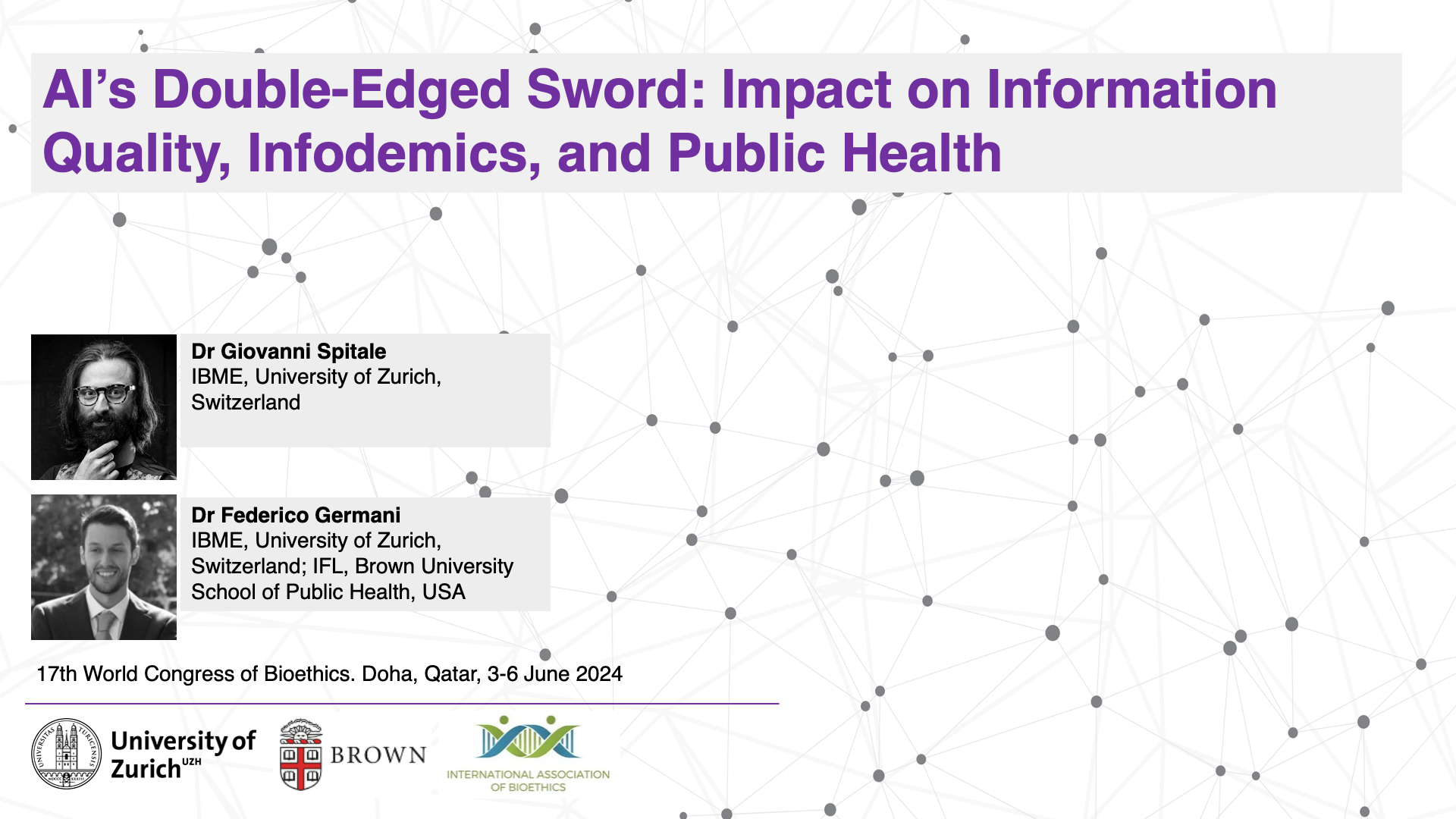
We presented this deck at the World Conference of Bioethics 2024 in Doha, Qatar.
Key Questions:
Can individuals discern whether a tweet, true or false, is authored by a human Twitter user or generated by the AI model GPT-3?
What is the potential impact of synthetic disinformation on public health issues such as infodemics, and how can it be mitigated?
Main Conclusions:
Our findings reveal the dual nature of GPT-3’s impact on information, which directly relates to the infodemic’s effect on global public health. On one hand, GPT-3 has the capacity to produce information that is both accurate and more comprehensible than human-generated content, potentially aiding public health communication efforts. However, it exhibits a concerning ability to generate highly persuasive disinformation, exacerbating the challenges posed by infodemics and putting public health at risk. Remarkably, participants in our study were unable to reliably differentiate between tweets authored by GPT-3 and those composed by genuine Twitter users, highlighting the potential for AI-driven disinformation to go undetected and harm public health. This study underscores the urgent need to address the role of AI in shaping the information landscape during times of crisis and calls for a holistic approach to harnessing AI’s potential for effective public health communication while safeguarding against its risks.