-
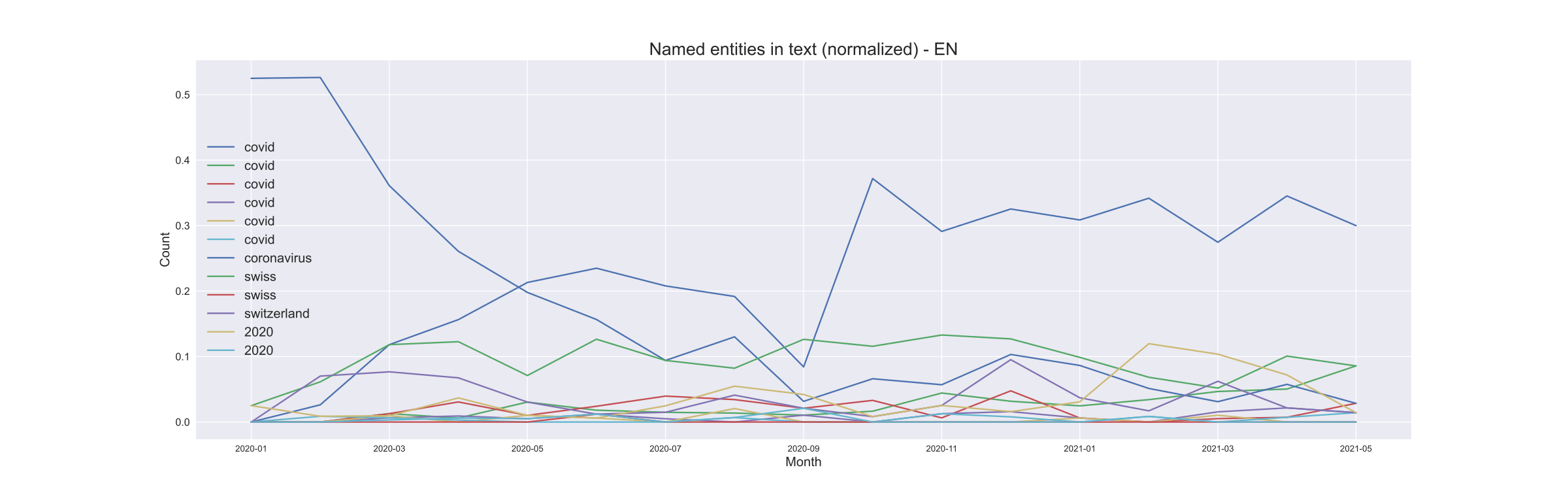
Factiva parser and NLP pipeline for news articles related to COVID-19
This bit of code was written quick and dirty to parse news articles retrieved from Dow Jones’ Factiva and feed them in a simple NLP pipeline. It works, it was fun to develop it, use it, recycle parts of the code, have fun 🙂 Parser: Takes as input files numerically ordered in a folder. This…
-
PubliCo. Together through the crisis@4th WHO Infodemics Conference
Surprise: this time there’s more than a deck of slides. There’s a video, because this was none other than the 4th WHO infodemic conference. PS: I think it’s the first time in history that someone presents stuff to a WHO event from Solagna, my tiny tiny ancestral home village 😛
-
Doing research in bioethics using empirical methods@DMM Postgraduate Course in Bioethics
I presented these slides during the Postgraduate Course in Bioethics 2020 – 2021 organized by the Department of Molecular Medicine of the University of Padova. Yay, back home! What is empirical ethics? A logical next step in the development of practical ethics after the turn to “applied ethics”. It can be both descriptive and normative,…
-

Along our skyline
C’è un giovane uomo che vuole provare qualcosa, inseguendo un sogno che fu di suo padre. Qualcosa che sarebbe impossibile senza il compagno giusto; qualcosa che non dimostrerà o cambierà alcunché, a parte la bellezza di provare. Prova a passare un paio di giorni in Valtournenche. Ogni mattina dal tuo letto puoi vedere il sole…
-
«I woke up from a nightmare, and I was still in a nightmare». An international study on COVID-19 patient’s experiences@DI
Slides presented at the DIPEx International Meeting 2020 In light of the DIPEx International commitment to study individual experiences that people have with health and illness, in order to understand where did people struggle and where did they learn, this research project aims to clarify what we can comprehend from the experiences of COVID-19 survivors…
-
PubliCo kickoff@Collegium Helveticum
Cooperative deck, including contributes on infodemics from Tim Nguyen (WHO), on the code from Giulio Michelon (Belka), on citizen science from Rosy Mondardini (CSCZH), on the implementation from Kristen Jafflin (IBME, SwissTPH), and on future perspectives from Nikola Biller-Andorno (IBME) and Sonja Merten (SwissTPH). More info on Publico here: https://t.uzh.ch/16v . PS: there’s also a…
-

Casa è un’atmosfera
La domanda non è “dov’è casa”. La domanda è: “cos’è casa”. A volte serve andarsene lontani per capirlo. Simon Messner ha trovato le sue risposte in Pakistan, da solo, sul Geshot Peak. Un mantra silenziosoSimon conta i passi, uno dopo l’altro, da sasso a sasso, da seracco a seracco, concentrandosi per non sprecare energie. È…
-

COVID-19 and the ethics of quarantine: a lesson from the Eyam plague
The Eyam Plague has been a dreadfully fascinating epidemic. The first response to plague epidemics in the seventeenth century was often quarantine, a measure detested by those who were subjected to it, and often violently opposed. In Eyam, however, things took a different turn: the parish priest William Mompesson persuaded the local population about the need…
-
Making sense in the flood. How to cope with the massive flow of digital information in medical ethics
This little paper discusses the (over)proliferation of academic publications and the impossibility of keeping pace with new literature. I define the issue and present a set of easily usable methodological strategies to cope with the flood. PS: maybe a bit less easy to use, but much more fun&powerful: The Mighty TopicTracker AbstractScientific publications have become the…
-
Vero o falso? Capire la realtà al tempo dell’infodemia: una questione di metodo@Verdi
Cosa vuol dire “infodemia”? Come orientarsi in un mare di informazioni, non sempre vere? Quali aspetti tenere d’occhio, nel contenuto o nel contenitore, per individuare una notizia falsa? Se queste competenze sono utili nella vita “normale”, l’epidemia di COVID-19 ci ha insegnato che ci sono contesti in cui si rivelano fondamentali. Il trucco? Beh, è…